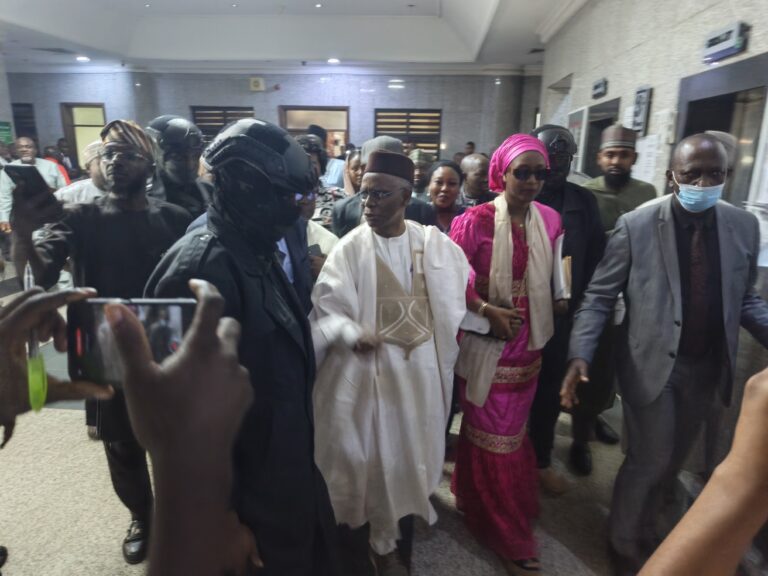
The recent clash between Defence Minister, Gen. Christopher Musa and former Kaduna State Governor, Nasir El-Rufai, over the killings in Southern Kaduna raises questions that go beyond the usual political exchanges.
Musa has accused El-Rufai of deliberately planning the killing of people in Southern Kaduna. He also alleged that El-Rufai told him that he paid bandits.
El-Rufai's camp has rejected the allegations and demanded an apology and N10 billion in damages, challenging the Defence Minister to produce evidence. That challenge is understandable. These are very serious allegations and should not be made lightly.
But there is another side of the matter that should not be ignored.
Gen. Musa is not an ordinary politician making an allegation from outside government. He is a retired four-star general, a former Chief of Defence Staff and the serving Minister of Defence. He has spent decades within Nigeria's military and security establishment and by virtue of his positions, would have access to security and intelligence information that is not available to the general public.
However, this is not a conclusive evidence does that everything he says should generally be accepted as fact and it does mean that it is too simplistic to dismiss his statement merely because he did not put an intelligence report on television.
The important question is, what informed Musa's allegation?
Was he speaking from personal knowledge, a conversation with El-Rufai, intelligence reports, security briefings or other information available to him in his capacity as a senior military and government official?
If intelligence informed his statement, the public may not necessarily be entitled to see the details, particularly where revealing sources and methods could compromise national security but the appropriate authorities should be able to examine such intelligence and determine whether it supports the allegation. This last suggestion is doubtful in Nigeria because the Nigeria military will always protect its own at all cost.
At the same time, intelligence should not become a convenient shield against accountability. If Musa is relying on information that cannot be publicly disclosed, there should still be a proper process for testing its credibility.
There is, however, a documented part of this story that cannot be ignored. In December 2016, El-Rufai himself said that his administration had traced some Fulani involved in the Southern Kaduna crisis and paid them in an effort to stop the killings and destruction of communities.
That admission is now central to the controversy.
Those defending Musa argue that if money was knowingly given to people involved in armed violence, the payment could have provided them with resources to acquire weapons, sustain their operations or continue attacks. From that perspective, the issue is not simply what the government called the payment, compensation or peace money but whether the recipients were armed groups and what they did with the money.
This view also should be handled carefully.
El-Rufai's admission that payments were made does not, by itself, prove that his administration financed terrorism.
There is a fundamental difference between paying people to stop violence and paying them to commit violence. To establish the latter, we need to know who received the money, how much was paid, why it was paid, whether the recipients were actually bandits or armed groups and what happened to the money afterwards.
Most importantly, there would have to be evidence that El-Rufai or his government knew they were funding people who were using the money to sustain terrorism.
The same applies to the far more serious allegation that El-Rufai deliberately planned the killings in Southern Kaduna.
Southern Kaduna had experienced violent communal, ethnic and religious conflicts long before El-Rufai became governor. The crisis cannot therefore simply be attributed to one administration. Neither does the fact that the conflict predated El-Rufai exonerate anybody who may have participated in or facilitated the violence.
This is where Musa's background becomes important. If the Defence Minister has information from the security establishment linking El-Rufai personally to the planning, sponsorship or financing of attacks, then that information deserves to be properly investigated. If there is no such intelligence and the allegation was based solely on personal recollection or hearsay, then that should also become clear.
In other words, the question is not simply whether Musa has produced evidence publicly.
The question is also what did he know, and what was the basis of his assertion?
The Middle Belt Forum has already called for an investigation into the alleged payments, while El-Rufai's supporters maintain that the payments were part of an attempt to end the violence and that there is no evidence they were used to buy weapons or carry out attacks.
Both sides have a point that deserves examination.
The public record establishes that payments were made. It does not, on its own, establish that El-Rufai financed terrorism. And there is currently no publicly established evidence proving that he deliberately planned the killings.
But Musa's position within the security establishment raises a legitimate question that should not be brushed aside, was his allegation based on intelligence that the public has not yet seen?
That is something the relevant security and investigative authorities should establish.
Until then, the fairest position is to distinguish between what is already established, what has been alleged and what remains unproven.
The Southern Kaduna tragedy deserves facts, not another round of political warfare.