
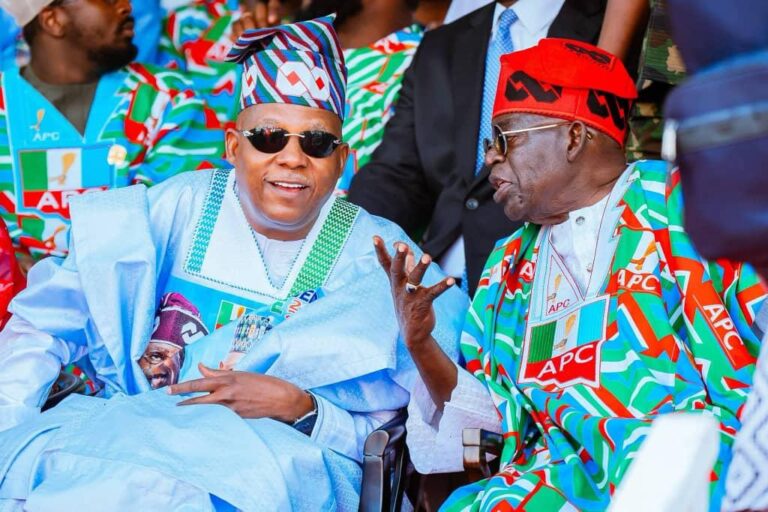
Tinubu made the allegation on Saturday at the flag-off of his re-election campaign at Ranchers Bees Stadium in Kaduna, challenging his political opponents to account for the country’s economic difficulties.
“I hear my opponents talking about hunger and poverty. Who created it? They did. They created the hunger; they created the poverty. We are trying to eradicate it,” the President said.
The declaration raises a central question ahead of the 2027 election: how much responsibility for Nigeria’s present economic hardship lies with previous administrations, and how much should be borne by the government that has been in power since May 2023?
While successive administrations have struggled with poverty, unemployment, inflation and weak public services, Tinubu’s government has introduced sweeping economic reforms, including the removal of the petrol subsidy and changes to the foreign exchange system.
The reforms have generated arguments over their long-term benefits and immediate costs. Although the government has defended them as necessary to stabilise the economy, millions of Nigerians have faced increased living costs, with food prices and transportation expenses placing additional pressure on household budgets.
The President’s remarks appeared directed at opposition figures, including former Vice-President Atiku Abubakar, who served under former President Olusegun Obasanjo from 1999 to 2007 and is now among Tinubu’s political opponents.
During the Obasanjo administration, the Federal Government pursued privatisation and commercialisation of state-owned enterprises. Some workers affected by the exercises reportedly suffered delays in receiving their pensions, gratuities and other entitlements.
Tinubu’s administration has been paying outstanding entitlements to some affected workers. However, the history of privatisation under previous governments does not, by itself, establish that the opposition created Nigeria’s wider problems of hunger and poverty.
The President’s accusation therefore sets the stage for a familiar political contest in which the ruling party points to the failures of its predecessors, while the opposition challenges the performance of the incumbent government.
Beyond the political exchanges, Tinubu used the Kaduna rally to highlight his administration’s infrastructure programme, particularly road construction across the North-West.
The President symbolically inaugurated an 81-kilometre section of the Abuja-Kaduna highway, part of the wider Abuja-Kaduna-Zaria-Kano Dual Carriageway project.
Works Minister Dave Umahi, who participated in the virtual commissioning of Lot 1 of the project, highlighted infrastructure development across the North-West and other parts of the country.
The Abuja-Kaduna highway is an important transport corridor linking the Federal Capital Territory with Kaduna and communities farther north. Improvements to the route are expected to support movement, trade and economic activity, although the project's wider benefits will depend on timely completion, road quality and effective maintenance.
Tinubu recalled Kaduna’s historical importance as a political and administrative centre of the former Northern Region. He also thanked residents for supporting him in the 2023 presidential election and urged them to renew his mandate in 2027.
He said his administration was investing in critical economic infrastructure across Kaduna State and the wider North.
Vice-President Kashim Shettima defended Tinubu’s political record, urging Nigerians to support the administration for another term.
He described the President as a politician committed to national unity and democratic stability, citing his support for Northern political leaders in previous presidential contests.
Shettima recalled Tinubu’s backing of former President Muhammadu Buhari, who won the 2015 and 2019 presidential elections. He also referred to Tinubu’s political relationships with other Northern figures, including Atiku Abubakar and Nuhu Ribadu.
According to the Vice-President, such relationships demonstrate Tinubu’s capacity to work across regional and political divides.
“We won the last election because you saw the best option before you,” Shettima told the crowd.
He urged Kaduna residents to remain supportive of the ruling All Progressives Congress (APC), arguing that continuity would help advance the country’s development.
The rally attracted APC National Chairman Prof. Nentawe Yilwatda, First Lady Oluremi Tinubu, several governors and other senior party figures.
Kaduna State Governor Uba Sani commended the President for supporting state governments in implementing development programmes.
He said cooperation between federal and state authorities was essential to sustainable progress, particularly in infrastructure, agriculture and citizens’ welfare.
Sani also acknowledged the First Lady’s contributions to programmes supporting women, children and families.
However, with political mobilisation for 2027 gaining momentum, the governor warned party supporters against misinformation, particularly misleading social media publications and material allegedly generated using artificial intelligence.
Abdulaziz Yari, Director-General of the APC Presidential Campaign Council, also defended the administration’s economic policies, pointing to developments in the foreign exchange market.
He urged Nigerians to assess the government on its policies and performance while expressing confidence in the APC’s ability to mobilise support for another presidential victory.
Yet, as the campaign begins, the decisive argument may extend beyond party loyalty, past administrations and infrastructure announcements.
For Nigerians struggling with the cost of food, transport, housing and other essentials, the critical question is whether the administration's policies will deliver measurable improvements in living standards before they return to the polls in 2027.
