
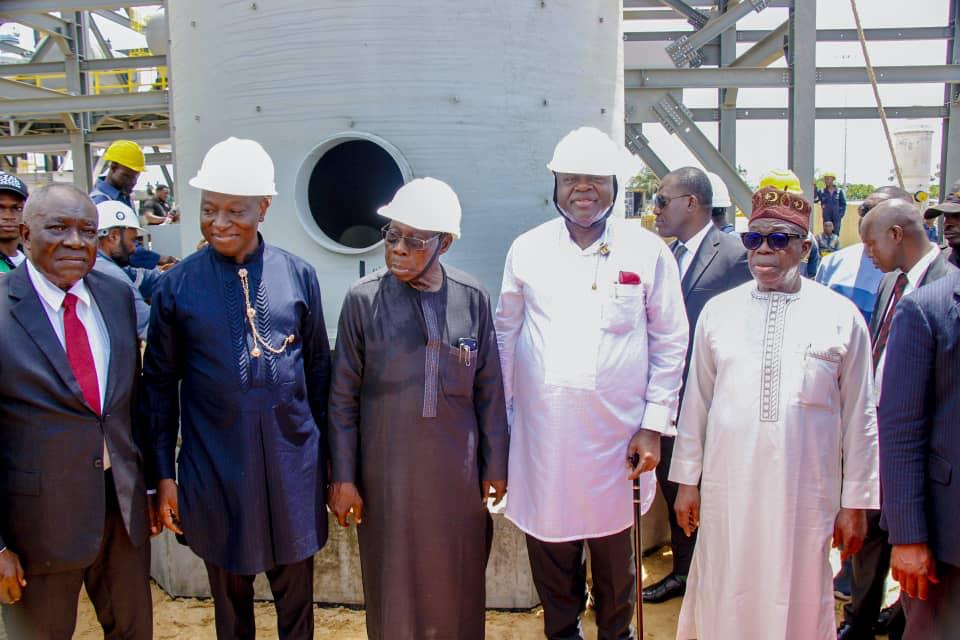
Former President Olusegun Obasanjo’s call for an increase in the 13 per cent derivation allocation to oil-producing states has renewed debate over resource ownership, revenue distribution and the economic rights of communities in Nigeria’s oil-rich Niger Delta.Obasanjo made the call on Monday, 13th October 2026, at the inauguration of the Crude Distillation Unit (CDU) of the $1 billion Azikel Refinery at Obunagha, in Yenagoa Local Government Area of Bayelsa.
“. . . .the oil-producing communities have not got a fair deal so far. Thirteen per cent is the beginning,” he told Bayelsa Governor Douye Diri, signalling support for efforts to negotiate a higher allocation.
The intervention comes amid longstanding grievances in the Niger Delta over the distribution of petroleum revenue, environmental damage associated with oil production and the limited role of producing communities in decisions concerning the resources extracted from their territories.
The derivation principle has been a contentious feature of Nigeria’s fiscal federalism since independence. Under earlier revenue-sharing arrangements, producing regions retained a significantly larger proportion of revenue derived from their natural resources.
However, successive changes under military rule reduced the derivation share substantially as the Federal Government assumed a greater role in controlling and distributing petroleum revenue.
The 1999 Constitution subsequently established a minimum derivation allocation of 13 per cent of revenue accruing to the Federation Account directly from natural resources, under Section 162(2).
Although the provision guarantees a share for producing states, it has not resolved disagreements over whether the allocation adequately reflects the environmental, social and economic costs of extraction or the region’s contribution to national revenue.
Obasanjo’s latest remarks are significant because they add the voice of a former head of state to calls for a review of the existing arrangement. He did not, however, specify a new percentage or announce a formal policy proposal.
Diri, in his remarks at the ceremony, argued that the existing formula did not give oil-producing states sufficient benefits or influence over their natural resources. He also criticised the Land Use Act and the constitutional framework governing mineral resources, contending that the distinction between state administration of land and Federal Government control of resources beneath it placed producing communities at a disadvantage.
“We do not want to take all to ourselves. We just want to be co-players in determining how it is done. Thirteen per cent is not enough for the states,” the governor said.
The governor’s position reflects a broader resource-control debate in which advocates seek not only a higher derivation allocation but also greater participation in decisions about petroleum exploration, environmental protection and the development of producing communities.
The issue also raises a competing national concern on how to balance the interests of resource-producing states with the need to distribute public revenue across the federation, including to states that do not produce oil.
The setting of Obasanjo’s remarks provided a practical dimension to the debate.
Owned by Azikel Petroleum under the Azikel Group, the refinery is designed to process crude oil locally and produce petrol, diesel and other petroleum products. Its promoters say it is expected to produce 2.5 million litres of petrol and two million litres of diesel daily.
Azikel Group President, Dr Azibapu Eruani, said the project was conceived to make Bayelsa and the wider Niger Delta active participants in the petroleum industry rather than remain primarily suppliers of crude oil.
Obasanjo laid the refinery’s foundation about eight years ago. The installation of the CDU marks a major stage in its development, although the project’s projected output should not be confused with verified commercial production.
The former president urged Eruani to complete the facility within 12 months and acknowledged the contributions of the African Finance Corporation, Afreximbank and the Bayelsa State Government.
He also commended Diri for the use of state revenue, saying that the funds received under the existing arrangement had supported development projects.
The refinery project highlights another dimension of the Niger Delta’s longstanding demands: greater local participation in the value chain through refining, industrialisation, skills development and employment.
For Bayelsa, a successfully completed and operational refinery could create opportunities beyond crude extraction. However, its actual contribution will depend on completion, reliable operations, financing, infrastructure, access to crude and the development of local technical capacity.
Diri urged residents to acquire the skills needed to benefit from the opportunities expected from the project. He also called on oil companies operating around Gbarain and Obunagha to rehabilitate the road leading to the refinery.
For the Niger Delta, the debate remains about more than the share of revenue returned to producing states. It concerns whether the communities that host petroleum operations can secure greater economic opportunities, environmental protection and a meaningful role in decisions affecting their resources.
Above all, Obasanjo’s intervention has brought the unresolved question back into national focus at a time when Bayelsa is also seeking to expand its role in the downstream petroleum industry.