
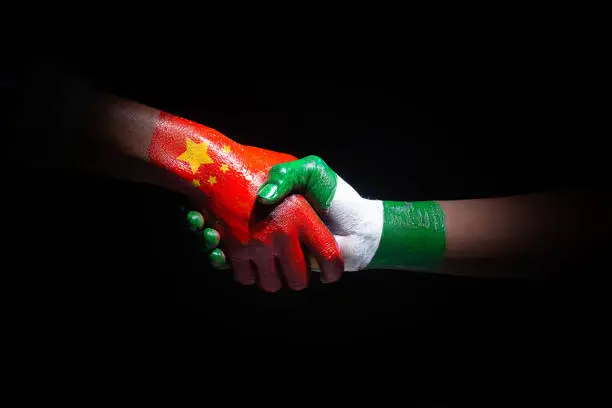
The recent demonstration by traders at the Lagos Trade Fair Complex over the alleged involvement of Chinese nationals in retail trading has raised legitimate questions about competition, immigration, business regulation and the future of Nigerian commerce.
But there is an even bigger question that the Lagos Trade Fair Complex business community must confront: is the battle really about Chinese traders in physical shops or is it about whether the market itself is prepared for the next generation of commerce?
Reports on the September 14 protest said Nigerian traders complained that some Chinese businesses that had traditionally operated as wholesalers were increasingly selling directly to consumers. Protesters argued that this gave the Chinese businesses an advantage because of their direct access to manufacturers and supply chains in China.
These concerns deserve investigation but so do some equally important questions.
For instance, who leased the shops to those Chinese businesses? Who approved their businesses? Who authorised the warehouses? Who granted the relevant planning and development approvals?
And perhaps most importantly:
Who says that every Chinese person doing retail business at the Lagos Trade Fair Complex is not a Nigerian?
A Chinese national working in Nigeria may have the appropriate work authorisation, residence status, business permit or other required documentation. Another may be operating through a Nigerian-registered company. And some people of Chinese origin living and doing business in Nigeria may have become naturalised Nigerian citizens.
If a person is legally a Nigerian citizen, then nationality or ethnic origin cannot by itself be used as a basis for treating that person as a foreign trader.
A naturalised Nigerian citizen is a Nigerian citizen.
That person should be subject to the same applicable laws as other Nigerians. If Nigerian law permits a Nigerian citizen to establish and operate a particular business, the mere fact that the person's ancestry is Chinese does not turn the business into a foreign business.
Equally, where a Chinese national remains a foreign national, the relevant question is whether that individual has the appropriate immigration, employment and business permissions required by Nigerian law.
Nobody should simply assume that a Chinese trader has no work permit.
Nobody should simply assume that a Chinese trader has one either.
The documents and the law should decide.
Is retail trading by Chinese nationals itself illegal?
This is another question that needs to be answered with facts rather than assumptions.
Nigeria's investment framework generally permits foreign investment, subject to applicable laws and restrictions. The Nigerian Investment Promotion Commission's framework also provides for requirements concerning business permits and expatriate quotas for foreign investors and expatriate employees.
Therefore, the fact that somebody is Chinese does not, by itself, establish that he or she has committed an offence by selling goods in Nigeria.
If there is a rule restricting a particular foreign national from engaging in a particular category of retail business, the authorities should identify that rule.
If there is no such restriction, then the issue becomes one of fair competition and compliance with ordinary business regulations, rather than nationality.
A trader cannot reasonably demand that a competitor be expelled simply because the competitor is Chinese if the competitor is operating lawfully.
On the other hand, if a particular business is violating immigration, tax, company, planning, customs or market regulations, those violations should be investigated and dealt with according to law.
The same standard should apply to Nigerian and foreign businesses.
What about Nigerians doing business in China? This makes the argument about reciprocity understandable.
Nigerians have travelled to China for many years to buy electronics, machinery, clothing and other goods. Nigerians have established commercial relationships there and Nigerians have also lived and worked in China.
But the fact that Nigerians do business in China does not automatically establish that every Nigerian can conduct every type of business there without complying with Chinese law.
The same principle applies in Nigeria.
If one may ask, What does Nigerian law permit and are the rules being applied consistently?
If Nigerians are permitted to undertake a particular business in Nigeria and foreign nationals are also legally permitted to undertake it under Nigerian law, there shouldn't be any objection simply because of nationality, afterall competition is part of the market economy.
If there are restrictions on foreign participation in a particular activity, those restrictions should be enforced.
There is, however, a much more difficult question for the Lagos Trade Fair Complex business community.
Nigerian traders have been in the electronics business for decades. The Lagos Trade Fair Complex has built an enormous commercial reputation around electronics, electrical equipment, appliances, spare parts and related products.
But much of the merchandise sold in the market is manufactured elsewhere.
China saw the opportunity.
Chinese companies built factories in China.
They developed manufacturing capacity.
They built supply chains.
They created distribution systems.
And Nigerian traders became some of the biggest distributors and customers of those products.
So the question now is, why should the Nigerian response to Chinese competition be primarily to chase Chinese traders away rather than to demand more Nigerian manufacturing, local assembly, technology partnerships and investment?
Instead of simply asking Chinese businesses to leave the retail market, Nigerian businesses should be asking:
Why aren't more Chinese manufacturers establishing factories and assembly plants in Nigeria?
Why aren't Nigerian traders using their knowledge of the Nigerian market to form manufacturing partnerships?
Why shouldn't the electronics trade evolve from importing finished products to assembling, manufacturing, branding, repairing and exporting products?
Those are questions that could create much more economic value than simply determining who occupies a particular shop.
Every generation of traders faces the same challenge
There is also an important lesson from the history of the market itself.
Some of the traders who dominate the business today were not necessarily the people who dominated it forty years ago.
There were traders and businesses operating in the same lines of commerce decades ago whose names were once prominent but who eventually lost their positions as a new generation entered the market, adopted different methods and captured customers.
The businesses that failed to adapt became less relevant and in some cases disappeared from the centre of the trade altogether.
Today's successful trader was once somebody else's competitor.
The current generation should therefore be careful about assuming that the business model that made it successful will remain dominant forever.
The same forces that allowed today's traders to overtake an earlier generation can eventually allow another generation to overtake them because
competition does not always arrive wearing a familiar face.
Sometimes it arrives through a new technology, a new distribution model, a new source of supply or a new generation of entrepreneurs.
it is therefore dangerous to force competition out of physical shops, if Chinese competitors are forced out of physical shops, they do not necessarily disappear from the Nigerian market.
They can move online.
And that could expose the market to an even more formidable form of competition.
A Chinese manufacturer does not necessarily need a shop at the Lagos Trade Fair Complex to sell to a Nigerian consumer.
The manufacturer can advertise online.
The distributor can sell through an e-commerce platform.
The consumer can order from a phone.
Payment can be made electronically.
Logistics companies can deliver the product.
The physical shop becomes less important.
That is the future the Lagos Trade Fair Complex must prepare for.
The question should therefore not simply be:
“How do we get the Chinese out of the Lagos Trade Fair Complex?”
It should also be:
“How do we make the Lagos Trade Fair Complex relevant when the customer no longer needs to physically come here?”
That is a much bigger business question.
The Lagos Trade Fair Complex must evolve before the wind of change blows
The history of Nigeria's entertainment industry provides a useful warning. We can all recollect that there was a time when video marketers and physical outlets were central to the production and distribution of Nigerian movies. The consumer went to a physical location to buy or rent a video.
Then technology changed the business.
Digital distribution, YouTube and social media transformed how Nigerian entertainment could reach audiences.
The physical video market did not remain the centre of the business simply because people wanted it to remain so.
The market evolved.
The Lagos Trade Fair Complex must recognise the same possibility.
The electronics and appliance business is increasingly capable of moving from physical shops to websites, social-media stores, WhatsApp commerce, online marketplaces and direct-to-consumer distribution.
Chinese companies and manufacturers are already deeply experienced in digital commerce.
If the Lagos Trade Fair Complex's response to competition is simply to remove Chinese traders from physical premises, it could unintentionally encourage competitors to develop stronger online channels into the Nigerian market.
And once Nigerian consumers become accustomed to ordering cheaper electronics online and having them delivered to their homes, getting those customers back into physical shops could become extremely difficult.
Hence, the real competition is not Chinese versus Nigerian
The real competition may eventually be old commerce versus new commerce.
A Nigerian trader who remains dependent entirely on a physical shop could lose business to another Nigerian trader who has built an effective online business.
Moreover, any person or company could compete online. The internet does not ask for your nationality before displaying a product to a customer.
This is why the Lagos Trade Fair Complex needs to look beyond the immediate protest.
Its traders have something that many foreign companies do not have, they have deep knowledge of Nigerian consumers, local distribution networks, product preferences, repair expertise and decades of commercial relationships.
Those advantages can be taken online.
Imagine a Lagos Trade Fair Complex where a trader can sell from a physical shop and through a sophisticated Nigerian e-commerce platform; where customers anywhere in Nigeria can order products; where traders aggregate their purchasing power to negotiate directly with factories; where Nigerian companies assemble or manufacture selected products locally; and where after-sales service and repairs become a competitive advantage.
This would be a very different Lagos Trade Fair Complex.
The authorities also have responsibilities. The government should not ignore the concerns of Nigerian traders.
The authorities should establish the facts.
If Chinese nationals are operating businesses, are they properly authorised?
If work permits are required, do those who need them have them?
If businesses require particular licences, have they obtained them?
If warehouses and buildings have been constructed, were the relevant planning and development approvals obtained?
If land interests have been granted or transferred, were the necessary legal procedures followed?
If particular market rules prohibit wholesale businesses from engaging in retail, do those rules actually exist and do they apply to the businesses concerned?
These are answerable questions.
Government should provide clear answers rather than leaving traders and foreign businesses to fight the matter themselves.
Above all, the future belongs to those who adapt
The Lagos Trade Fair Complex demonstration should therefore become more than a protest about Chinese traders.
It should become a wake-up call.
The history of commerce shows that no generation owns a market forever.
The traders who are dominant today once benefited from changes that displaced those who came before them. Another generation can do the same to them if they fail to adapt.
The challenge, therefore, is not simply to determine who occupies the shops today.
It is to determine who will still be relevant when the way Nigerians buy, sell and receive goods has fundamentally changed.
The future will belong to businesses that can compete not only in physical markets but also in manufacturing, technology, supply chains, digital commerce, branding, distribution and customer service.
The question for the Lagos Trade Fair Complex is not whether change is coming.
It is whether the market will adapt before change makes adaptation unavoidable.
