
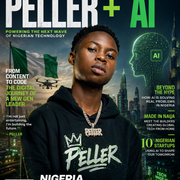
Reno Omokri's latest intervention on artificial intelligence, education and the rising fortunes of Nigerian content creator Habeeb Hamzat, popularly known as Peller, has generated a debate that goes beyond one young entertainer.
Beneath it lies a bigger question of what kinds of human abilities will retain their value as artificial intelligence takes over more of the work traditionally performed by people?
In “Peller and the Olodo Uprising: An Unpopular Opinion,” Omokri argues that qualities such as spontaneity, humour, warmth, playfulness and the ability to connect with people may become increasingly valuable in an AI-driven economy.
He describes Peller as a “money spinner” and urges parents not to judge their children solely by academic performance.
His broader point is that the world of work is changing and Nigerians may need to rethink the traditional equation of good grades, professional qualifications and conventional employment with success.
There is evidence to support part of this argument but there is also a danger in taking it too far.
There is no doubt AI is already disrupting entry-level work
Recent reports from advanced economies suggest that AI is already affecting the bottom of the professional career ladder.
Reuters reported on August 25 that more than one-third of UK employers surveyed had reduced entry-level opportunities over the previous year, with AI and automation among the contributing factors.
Another Reuters report, citing a Swiss study, found that junior positions in occupations highly exposed to AI had fallen significantly while senior positions increased.
This matters because many professional careers have traditionally depended on juniors doing routine work before gradually acquiring the experience required for senior responsibilities.
AI can now research documents, analyse information, write code and prepare summaries, tasks that once gave young professionals their first rung on the career ladder but replacing tasks is not necessarily the same as replacing people.
Companies still need people who can exercise judgement, understand clients, manage others, persuade decision makers and take responsibility for outcomes. Even as AI changes junior work, some firms continue to recruit graduates and interns.
The emerging picture is therefore not simply AI versus humans. It is AI performing some tasks while humans move towards work involving judgement, relationships, responsibility and implementation but even this distinction may not last forever.
What Peller's success story tells us
This is where Omokri's Peller argument deserves to be taken seriously.
Peller's success challenges a particularly strong Nigerian assumption that academic performance is the principal measure of intelligence and future economic value.
A young person who is exceptionally good at entertaining people, attracting attention, building relationships or creating a loyal audience possesses a form of capital that a certificate does not necessarily measure.
Nigeria has already demonstrated the economic potential of this through music, film, comedy and digital content. Nigerian creators can reach audiences far beyond the country's borders, turning culture and personality into commercial products.
Peller therefore illustrates a genuine change in the economy.
However, he should not be turned into an argument against education because for every creator who becomes enormously successful, there are many more who do not.
Moreover, Nigeria still needs doctors, engineers, scientists, teachers, lawyers, accountants, researchers, technicians and software developers.
The sensible conclusion is not that children should stop pursuing conventional education. It is that education should no longer be treated as a sufficient measure of a person's potential. I guess that was Reno's message.
But is creativity really AI-proof?
This is where Omokri's strongest claim requires caution. AI is already capable of producing jokes, stories, music, images and videos. As the technology develops, it may become increasingly capable of producing entertainment that audiences find convincing and enjoyable.
It is therefore not enough to say that AI cannot imitate a comedian. The more important question is whether it can eventually reproduce the things that make the comedian economically valuable.
Today, Peller's advantage is not simply his content. It is his identity, cultural context, personality, relationships and connection with an audience.
But these advantages may not be permanently protected.
An AI system could eventually maintain a recognisable personality, understand cultural references, remember interactions, respond to millions of viewers and produce entertainment continuously. It could even develop its own following.
If this happens, AI may compete not only with junior lawyers and analysts but also with creators.
This does not mean human creators will disappear. Audiences may continue to value authenticity, live performance, personal experience and human connection but those should not be treated as permanently AI-proof.
The deeper lesson is that no occupation is guaranteed to remain valuable simply because it is valuable today.
That changes the meaning of the Peller story. He is not proof that creators will defeat AI.
He is evidence that economic value can come from abilities that traditional education does not always measure, while also reminding us that the economic value of those abilities can change.
Nigeria needs both productivity and creativity
The debate becomes even more important in the Nigerian context. For generations, parents have encouraged children to pursue professions considered secure and respectable. The familiar “see your mate” culture reflects a society where academic achievement is often used as shorthand for future success.
But the answer is not to replace one narrow definition of success with another.
It would be just as misguided to tell every young Nigerian to become a content creator as it is to insist that everyone must become a doctor, lawyer or engineer.
Nigeria needs both the engineer and the entertainer.
It needs the scientist developing new technology and the creative telling Nigerian stories to the world.
It needs people who can build businesses, operate machines, analyse data, write software, entertain audiences and persuade others.
Another important point is why advanced economies have such large entertainment and leisure industries. It must be noted that their prosperity did not come from choosing comedy over science and industry.
Their creative industries grew alongside industrialisation, the enormous scale of which was made possible by productivity, infrastructure, technology, disposable income and global markets.
Nigeria therefore should not mistake the visible prosperity of entertainment for the foundation of prosperity. It needs reliable electricity, infrastructure, education, research, industrial capacity, technology and productive businesses. There is no reason it cannot build those foundations while exploiting its considerable creative strengths.
Indeed, AI could create new opportunities for Nigerian creators by lowering the cost of producing films, animation, advertising, music and other digital content for global audiences. At the same time, however, the same technology will lower barriers for competitors everywhere.
Perhaps the most serious issue raised by the AI evidence is not that humans will become redundant but that AI could disrupt the traditional process through which young people become experienced professionals.
The junior lawyer learns by doing junior legal work. The young accountant learns from experienced accountants. The junior consultant learns through research and client assignments.
If AI performs much of that routine work, companies will have to find new ways to train the next generation.
The future junior employee may therefore be valued less for performing repetitive tasks and more for the ability to learn, use AI, understand an industry, communicate and eventually exercise independent judgement.
For Nigeria, this has major implications.
The country cannot simply produce graduates and assume that the traditional employment ladder will absorb them. Young Nigerians will need technical skills, digital literacy, creativity, communication, adaptability and entrepreneurial capacity.
In conclusion, Omokri is right to challenge the idea that academic performance is the only reliable indicator of intelligence or future success. He is also right that humour, creativity, communication and relationship building have economic value.
However, it would be a mistake to conclude from Peller's success that education, science and professional expertise are becoming obsolete.
Nor should we assume that creativity and comedy are permanently beyond the reach of AI.
The more convincing lesson is that the value of human skills is changing and may continue to change as AI becomes more capable.
Knowledge that can be cheaply reproduced by a machine may become less valuable on its own. Judgement, leadership, trust, relationships and the ability to turn knowledge into action may become more valuable. But even these qualities may increasingly be augmented or imitated by technology.
For Nigeria, the answer should therefore not be to choose between the classroom and the creative economy. It should be to strengthen both.
Peller may be a useful symbol of the fact that success can come from places the traditional education system does not always recognise but his story should not lead us to undervalue education or to assume that his particular route to success will remain AI-proof forever.
The lesson for Nigerian parents is simple, educate the child but do not reduce the child to his grades.
And for policymakers, the lesson is bigger, prepare Nigerians not merely for today's jobs but to learn, adapt and use technology as the economy changes.
This is a more realistic response to the AI revolution than either the fear that machines will replace everyone or the comforting belief that human creativity will automatically remain untouched.