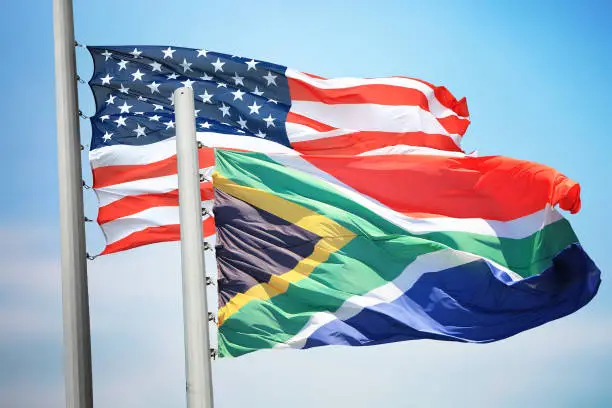
Nigeria has once again taken Africa's demand for permanent representation on the United Nations Security Council to the world stage.
At the 81st session of the UN General Assembly, President Bola Ahmed Tinubu, represented by Vice President Kashim Shettima, called for at least two permanent seats for Africa, with veto power for as long as the veto remains part of the Security Council's structure. Nigeria also supports five non-permanent African seats.
The argument for greater African representation hinges on the fact that Africa has 54 countries, accounts for a significant share of UN membership, contributes personnel to international peacekeeping and is frequently at the centre of discussions on international security, conflict and development. Yet no African country has a permanent seat on the Security Council.
But there is a question about what exactly would a permanent seat give Africa if the continent does not simultaneously build the economic, technological, military and political capabilities needed to make that seat consequential?
A permanent seat would give Africa institutional power. It would give African representation a permanent place within one of the world's most important decision-making bodies but institutional power is not the same thing as material power.
But the five current permanent members of the Security Council, China, France, Russia, the United Kingdom and the United States did not acquire their broader geopolitical influence simply because they were given permanent seats. Their permanent status reflected the concentration of military, economic and geopolitical power among the victorious Allied powers when the post-Second World War international order was created.
The seat institutionalised that power. It did not create it from nothing.
Looking beyond the UN building and considering countries such as Israel and Iran. Neither is a permanent member of the Security Council, yet they both exercise considerable influence in the Middle East. Israel's influence is associated with its military capabilities, technological strength, economic capacity and strategic relationship with the United States, among other factors.
Iran has also built substantial regional influence without a permanent Security Council seat. Its strategic geography, military capabilities, energy resources and regional networks have given it significant leverage.
The lesson is not that Africa should copy either country because their political systems, strategic circumstances and regional environments are fundamentally different from Africa’s, but the lesson is that geopolitical influence does not begin and end with a seat at the Security Council.
The same distinction can be seen in Germany, Japan and India.
Germany and Japan are not permanent members of the Security Council, yet both possess substantial economic and industrial weight and play important roles in international affairs. Both are also among the countries seeking permanent membership.
India provides perhaps the clearest illustration of the distinction. It is one of the world's largest economies, a nuclear-armed state, a major military power and a country of enormous demographic and strategic importance. Yet it does not have a permanent Security Council seat.
India's experience demonstrates that a country can accumulate substantial international influence without possessing permanent membership. A permanent seat would add another layer of institutional influence but it would not create India's economic, military, technological or demographic capabilities.
Africa possesses extraordinary aggregate advantages. For instance, it has more than a billion people. It has vast land and natural resources, including oil, gas, gold, lithium, uranium, cobalt and other minerals of strategic importance. It has a young and rapidly urbanising population, some of the world's fastest-growing cities and the potential to become one of the world's major consumer markets.
But these advantages are distributed across more than fifty sovereign states. Africa is not a single economy, government or military power.
The challenge, therefore, is not simply that Africa lacks resources. It is that African countries have often struggled to convert their combined demographic, natural-resource and market advantages into comparable economic and geopolitical leverage.
Too much of the continent's economy remains dependent on the export of raw materials and the import of higher-value manufactured goods.
African countries frequently negotiate individually with much larger economic powers rather than negotiating from the strength of an integrated continental market.
Many African states remain heavily dependent on foreign technology, foreign capital, imported military equipment and external financing.
This is the gap between possessing resources and possessing power.
A permanent Security Council seat cannot manufacture an aircraft engine.
It cannot build a semiconductor industry.
It cannot strengthen a currency.
It cannot create a world-class university or research ecosystem.
It cannot turn African minerals and crude oil automatically into globally competitive industrial products.
And it cannot stop African countries from competing against one another for foreign investment.
Those capabilities must be built through economic policy, industrialisation, education, infrastructure, research, investment and political cooperation.
This is why Nigeria needs two conversations.
The first is the conversation Nigeria is already having, that Africa deserves permanent representation on the Security Council.
The second is more difficult, what is Africa doing to build the power that will make that representation consequential?
It is industrialising.
It means processing African minerals in Africa.
It means developing stronger manufacturing industries.
It means reliable electricity and transport infrastructure.
It means investing in education, scientific research and technological innovation.
It means building African companies capable of competing internationally.
It means stronger African financial institutions and deeper capital markets.
It means increasing intra-African trade and making the African Continental Free Trade Area more than a diplomatic agreement on paper.
It means developing modern armed forces capable of protecting African interests while reducing excessive dependence on foreign suppliers.
And it means governments capable of providing stability, predictable rules and institutions that encourage long-term investment.
These may not be glamorous subjects at the United Nations.
They are, however, the foundations of power.
There is an interesting irony in Nigeria's position.
Nigeria's own argument for greater African representation does not exist in isolation from this economic question. President Tinubu's address also emphasised the need for Africa to move beyond its historical role as an exporter of raw materials and towards greater value addition, manufacturing, technological innovation and knowledge-driven growth. The speech also highlighted the African Continental Free Trade Area as an opportunity to strengthen regional value chains and industrialisation.
The debate should therefore not be framed as a choice between demanding a permanent Security Council seat and building African economic power.
Africa needs both.
The mistake would be to assume that one can substitute for the other.
If Africa becomes a major manufacturing centre, a technological force and a genuinely integrated economic market, its bargaining power will rise regardless of what happens inside the Security Council.
If Nigeria, for example, becomes an industrial and technological powerhouse, other countries will have strong reasons to listen to it whether or not it possesses a veto in New York. Under such circumstance, a permanent Security Council seat would then serve as an amplifier of Nigeria power rather than a substitute for it.
But there is another fundamental question that African governments must answer: if Africa obtains two permanent seats, who will actually occupy them?
The African Union's position calls for at least two permanent seats for Africa but Africa is not a single political entity. It consists of more than fifty sovereign states with different national interests, political systems, economic priorities, security concerns and foreign-policy positions.
So which countries would represent the continent?
Would they be Nigeria and South Africa?
Egypt and Algeria?
Nigeria and Egypt?
Would the seats rotate among the continent's regions?
Would they be assigned permanently to particular countries?
And, perhaps most importantly, what mandate would those countries have when their national interests differed from the collective position of the African Union?
This is question is definitely not a minor administrative question.
A permanent seat allocated to Africa would raise difficult questions about representation, accountability and decision-making. The country occupying such a seat would inevitably bring its own national interests, strategic priorities and foreign-policy calculations to the Security Council.
Nigeria's security priorities, for example, are not identical to Ethiopia's. Egypt's strategic concerns are not necessarily the same as Kenya's. The priorities of North Africa may sometimes differ from those of West, East, Central or Southern Africa. It must be remembered that the current permanent members of the UN Security Council represent their respective national interests, not those of their continents.
A permanent African seat could therefore create a new institutional challenge of how one or two national governments exercise Security Council authority while remaining accountable to the wider continent.
The African Union would need a credible mechanism for answering questions such as who selects the representatives, how long they serve, how regional interests are balanced, how positions are coordinated and how the representatives are held accountable.
Otherwise, Africa could achieve greater representation at the Security Council while leaving unresolved the question of who, precisely, that representation is supposed to serve.
The deeper question, therefore, is not whether Africa deserves permanent representation. It is whether Africa can build the economic, technological, military and political capabilities that allow permanent representation to produce lasting influence.
Furthermore, it must not be overlooked that institutional power is strongest when it is backed by material capability.
For example, Germany has considerable economic weight.
Japan has substantial technological and industrial capabilities.
India combines economic, military, technological and demographic weight.
Israel has developed significant military and technological capabilities and maintains an important strategic relationship with the United States.
Iran has demonstrated that substantial regional influence can be built without permanent Security Council membership.
Africa must develop its own combination of these forms of power according to its own circumstances.
The objective should therefore not be to choose between a permanent Security Council seat and economic transformation.
It must pursue both.
Africa should demand a permanent voice in the institutions that govern international security while simultaneously building the industrial capacity, technological capabilities, financial institutions, military capacity and integrated market necessary to make that voice consequential.
Then the question will no longer simply be, "Why doesn't Africa have a permanent seat?"
It will also be, "How can the world make decisions about global security without taking Africa's interests and capabilities into account?"
At this point the permanent seat will become more than a diplomatic achievement. It will become an institutional reflection of power Africa has already built.
Afterall, power is not merely having a seat at the table.
It is having enough capacity and influence to help determine what is placed on the table.